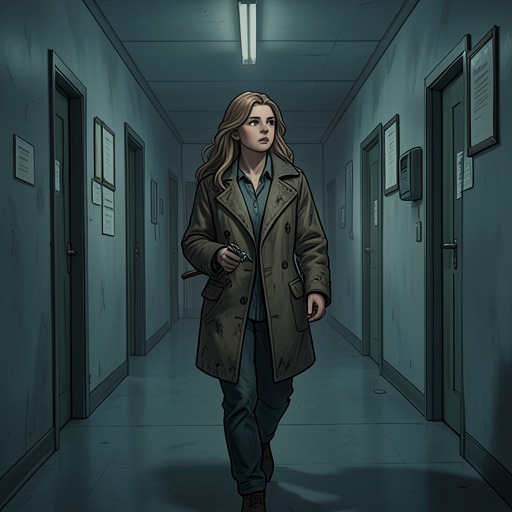
Shen Xiuxiu
I’m Very Happy After Marrying the CEO Husband According to the AgreementShen Xiuxiu is Shen Tang’s missing mother and the Shen family’s long-lost daughter. Although she is absent from most of Shen Tang’s life, her disappearance governs the family’s grief, the mystery of Shen Tang’s origins, and the painful distinction between biological kinship and the people who actually provide care. Her story is recovered only after Shen Tang’s face is recognized as resembling hers, turning a chance family investigation into a belated confrontation with love, rebellion, abuse, and loss.
Identity and Family Background
Shen Xiuxiu was the only cherished daughter of a scholarly family. Her relatives had doted on her, and the old photograph shown to Shen Tang presents her as a striking young woman in a cheongsam, holding a paper umbrella and smiling at the camera. The image supplies the family with an idealized memory of the daughter they lost, while its resemblance to Shen Tang makes inheritance visible before it is legally confirmed. Shen Tang is told that the woman in the photograph looks almost exactly like her, though Shen Tang considers herself slightly less beautiful; the comparison nevertheless gives physical form to a relationship that had previously existed only as rumor and absence.
Shen Xiuxiu’s family called her Xiuxiu, the same name that an elderly woman in a hospital mistakenly used for Shen Tang. That earlier encounter becomes newly significant when Shen Tang learns from Shen Yu that he has a long-lost older sister, the daughter of his aunt Shen Xiu. Shen Tang asks whether the missing aunt was called Xiu Xiu, but immediately denies that the coincidence proves anything, explaining that she had merely met an old lady who addressed her that way. The exchange shows how recognition arrives indirectly: memory, resemblance, and a name begin reconstructing Shen Xiuxiu before the family can establish the full truth.
Rebellion, Separation, and the Lost Child
When Shen Xiuxiu entered college, she met Wei Xuan. According to Shen Boyuan’s account, the relationship changed her conduct so completely that the family felt she had become rebellious and insisted on staying with him. The family’s opposition was not only a disagreement over romance. Shen Xiuxiu eventually became pregnant outside marriage, and the Shen family intended to make her undergo an abortion. Under Wei Xuan’s influence, she instead ran away from home.
Her departure was starkly deliberate: she took none of the valuable belongings in the family home and left only a letter. The letter is the sole object mentioned as her final trace when she disappeared, giving the separation a quality of both declaration and severance. For the family, her leaving transformed a conflict over filial authority and marriage into a permanent loss. For Shen Tang, it created a life in which her mother’s identity was concealed, fragmented, and repeatedly encountered through other people’s recollections.
Abuse, Death, and the Vanished Family
The family eventually found Shen Xiuxiu in a condition far removed from the glamorous young woman preserved in the photograph. Shen Yu’s mother recounts that Xiuxiu looked much more haggard than before and that her body was covered with bruises from long-term abuse. She had been struck in the head and was already near death when a neighbor sent her to the hospital. Her death therefore emerges not as an abstract disappearance but as the result of sustained domestic violence and a final assault severe enough to leave her dying.
The relatives went to Wei Xuan’s home searching for him and the child, but Wei Xuan had vanished without a trace. Shen Tang was gone as well. More than a decade passed before she stood before the family again. The delayed discovery binds Shen Xiuxiu’s death to the mystery of Shen Tang’s childhood: the mother was killed, the father disappeared, and the child was removed from the family’s knowledge at the same moment. Shen Boyuan admits that he sometimes thinks that arriving only a little sooner might have saved his sister, an expression of survivor’s guilt that makes the family’s grief active rather than finished.
Recognition and Afterlife in the Plot
Shen Xiuxiu’s place in the present is confirmed through both resemblance and medical testing. Shen Boyuan sees Shen Tang clearly and immediately notices how alike she is to Xiuxiu; his wife reacts with tears and maternal tenderness, telling Shen Tang that she has suffered over the years. The old photograph reinforces the visual link, while the hospital’s test supplies the formal confirmation: the doctor announces that Shen Tang and the family do share a blood relationship. Shen Xiuxiu’s maternity is thus established through a sequence that moves from mistaken naming, to bodily resemblance, to family testimony, and finally to biological proof.
The Shen family has preserved Shen Xiuxiu’s room exactly as it was. Shen Lady takes Shen Tang to see the spotless room, where the bed sheets and blankets remain in place as though someone might still be living there. This carefully maintained space is a material memorial to the missing daughter. It also gives Shen Tang a physical setting in which to imagine the mother she never knew, while making the family’s care legible through preservation rather than direct reunion. Shen Xiuxiu cannot return to the room, but the room keeps her absence present.
Motherhood, Inheritance, and Thematic Significance
Shen Xiuxiu’s story complicates the meaning of family in Shen Tang’s life. Shen Tang has been raised in an orphanage and treats its children as siblings; one eight-year-old child with leukemia is described as her brother even though they are not biologically related. She has spent her savings helping the orphanage, and the original Shen Tang’s wish to become successful and earn money is connected partly to supporting those children. Against that background, Shen Xiuxiu’s blood relationship matters deeply, but the narrative does not make blood the only measure of belonging. Shen Tang’s family history contains both biological abandonment and sustained, practical care among people who are not related by blood.
The recovery of Shen Xiuxiu’s history also makes inherited guilt one of the central emotional consequences of reunion. After learning that Wei Xuan abused her mother and that his blood runs through her own veins, Shen Tang feels contaminated by the connection. The feeling is not presented as a factual moral judgment; it is the emotional residue of a violent lineage that she did not choose. Shen Xiuxiu’s fate therefore affects Shen Tang in two opposite ways: resemblance gives her a family and a history, while resemblance also exposes her to the shame and grief attached to the man who destroyed that history.
Shen Xiuxiu remains a character defined largely through traces—an old photograph, a misremembered name, a preserved bedroom, a letter, bruises described by witnesses, and the relatives’ belated arrival. Yet those traces make her more than a plot device for Shen Tang’s parentage. Her life reveals the cost of a family order that treated her pregnancy and relationship as matters to be controlled, while her death records the greater violence enabled by Wei Xuan’s disappearance and abuse. Her absence propels Shen Tang toward the Shen family, but it also forces that family to confront the limits of its earlier authority, its failure to protect Xiuxiu, and the decades of grief left behind when a daughter and her child vanished together.